Are you looking for a trust lawyer in Kalispell, MT?
Schedule a consultation with an experienced Kalispell trust lawyer today.
If you own property, have minor children, or want to control how your assets are distributed after your death, a trust may be the right estate planning tool to achieve your goals. Trusts serve different purposes depending on how they are structured, and the tax consequences of choosing one type over another can be significant. Silverman Law Office, PLLC has drafted, amended, and administered trusts for Montana families and business owners since 2012. Our attorneys bring more than 20 years of experience in estate planning and tax law to every trust matter. Kalispell, MT trust lawyers can help you determine which structure fits your situation. Contact our office to schedule a consultation.
Trust Lawyer Kalispell, MT
A trust is a legal arrangement in which one party holds property for the benefit of another. The person who creates the trust is called the grantor. The person who manages it is the trustee. And the people who benefit from it are the beneficiaries. That structure sounds simple, but the legal and tax implications of each decision within it are not.
Kalispell is one of the fastest-growing cities in Montana, with a population exceeding 28,000 according to U.S. Census data. Rapid growth in property values across Flathead County has increased the number of families whose estates would benefit from trust planning. Homes, vacation properties, investment accounts, business interests, and retirement savings all raise questions about how assets will transfer and what tax obligations attach to that transfer. Montana’s Uniform Trust Code governs the creation, administration, and modification of trusts in the state.
Types of Trust Cases We Handle in Kalispell
Trust planning is not one-size-fits-all. The type of trust that works for a retired couple with a paid-off home is different from the one that suits a business owner with commercial real estate and active operations. Our attorneys handle the following types of trust matters for clients in Kalispell, MT, and across Flathead County.
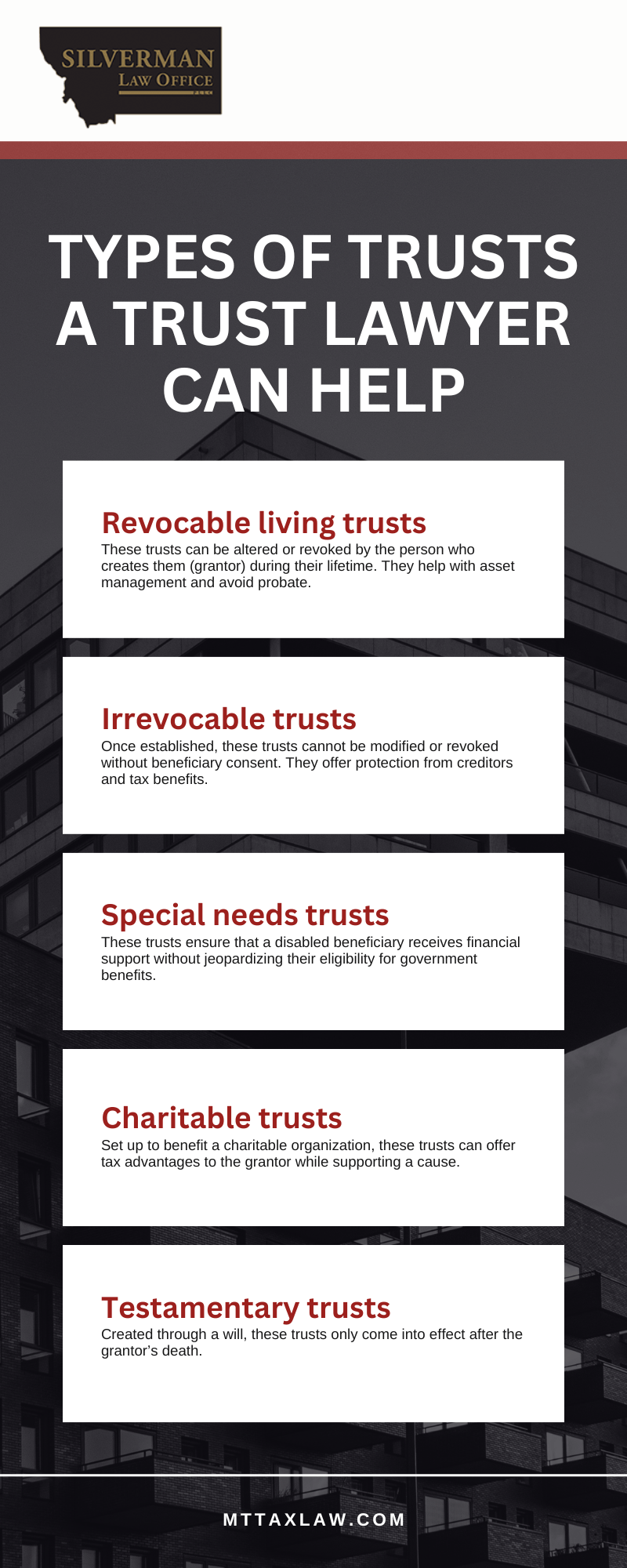
- Revocable living trusts. A revocable trust allows the grantor to retain control of the assets during their lifetime and change or revoke the trust at any time. At death, the assets pass directly to the named beneficiaries without going through probate. Families considering this option should understand what a living trust does and does not accomplish.
- Irrevocable trusts. Once established, an irrevocable trust generally cannot be modified or revoked by the grantor. That rigidity comes with benefits: assets placed in an irrevocable trust are typically removed from the grantor’s taxable estate and may be protected from creditors. These trusts are used for long-term asset protection and estate tax reduction, particularly for larger estates.
- Special needs trusts. A trust designed for a beneficiary with a disability must be structured to preserve the beneficiary’s eligibility for government benefits like Medicaid and Supplemental Security Income. The drafting requirements are specific, and errors can disqualify the beneficiary from programs they depend on.
- Trusts for tax planning. The intersection of trust law and tax law is where much of the complexity lives. Trust income is taxed differently depending on whether distributions are made to beneficiaries or retained in the trust. Grantor trusts, nongrantor trusts, charitable trusts, and generation-skipping trusts all carry different tax treatment, and the right choice depends on the grantor’s goals and the size of the estate.
- Trust administration and funding. Creating a trust is only part of the work. The trust must be funded, which means retitling assets, updating beneficiary designations, and recording deeds into the trust’s name. A trust that is created but never funded accomplishes nothing. After the grantor’s death, the successor trustee must administer the trust according to its terms and Montana law, a process that involves specific duties and obligations under the Uniform Trust Code.
- Trust amendments and restatements. Circumstances change. Marriages, divorces, births, deaths, and shifts in financial position all create reasons to update a trust. Some changes require a simple amendment. Others call for a full restatement of the trust document. Knowing when to update the structure is part of responsible estate planning.
- Wills. Most estate plans that include a trust also include a pour-over will, which directs any assets not titled in the trust at the time of death to flow into it. A will and a trust serve different but complementary purposes, and few estate plans are complete with only one of them.
- Probate. One of the primary advantages of a trust is that assets held in it avoid probate. But any asset that was not properly funded into the trust at the time of death will go through the court-supervised probate process. Understanding that relationship is essential for families trying to minimize court involvement in the transfer of property.
Kalispell Trust Infographic
Why Choose Silverman Law Office, PLLC as My Trust Lawyer in Kalispell, MT?
Why Tax Knowledge Matters for Trust Planning
The firm is led by Joel Silverman, its founder and CEO, who has practiced law in Montana for more than two decades. Joel completed his Juris Doctor and LL.M. in Taxation at the University of San Diego Law School after graduating from the University of Colorado. His bar admissions include the State Bar of Montana, the U.S. Tax Court, and the U.S. District Court for the District of Montana. Joel is a member of the American Bar Association and the Montana Trial Lawyers Association, and the Helena Area Chamber named him Businessperson of the Year.
Trust planning without tax analysis is incomplete. Every trust structure carries income tax, estate tax, and potentially gift tax implications. A revocable trust is taxed as part of the grantor’s estate. An irrevocable trust may remove assets from the estate but triggers its own income tax obligations. The wrong choice can cost a family tens of thousands of dollars. Joel’s tax law training allows our firm to design trust structures that account for both the legal protections and the tax consequences from the outset. Our firm has successfully worked with families across the Flathead Valley on trust structures of every size.
Understanding Trust Cases
Key Trust Concepts and How They Work
Trusts operate under Montana’s Uniform Trust Code, which establishes the rules for creating, modifying, and administering them. Several foundational concepts apply across most trust matters:
- Grantor, trustee, and beneficiary. The grantor creates the trust. The trustee manages it. The beneficiary receives the benefit. In a revocable trust, the grantor often serves as trustee during their lifetime, with a successor trustee named to take over at death or incapacity.
- Revocable vs. irrevocable. A revocable trust can be changed or dissolved at any time by the grantor. An irrevocable trust, once funded, generally cannot be altered without court approval or the consent of all beneficiaries.
- Funding. A trust must be funded to be effective. Real property requires a new deed. Bank and brokerage accounts must be retitled. Beneficiary designations on retirement accounts and insurance policies must align with the trust’s terms.
- Fiduciary duty. The trustee owes a fiduciary duty to the beneficiaries, which includes the obligation to act in their best interest, avoid self-dealing, keep accurate records, and provide accountings upon request.
What Are Important Aspects of a Trust Case?
The details that matter most in trust work often emerge during the planning stage rather than after the trust is signed. Getting the structure right prevents costly corrections later.
- Identifying all assets and determining which belong inside the trust and which are better handled through beneficiary designations or other transfer mechanisms.
- Choosing the right trustee, both for the initial term and for succession, is a decision that affects the trust for decades.
- Coordinating the trust with other estate planning documents, including wills, powers of attorney, and healthcare directives, so the entire plan functions as a whole.
- Reviewing the trust periodically, especially after major life changes such as a marriage, divorce, birth of a child, or acquisition of significant property.
What Is the Trust Creation Timeline?
Creating a trust is not an overnight process, but it does not take months either. A general timeline in our office follows this sequence:
- The initial consultation involves a review of the client’s assets, family situation, and goals. This meeting typically lasts about an hour.
- After the consultation, our attorneys draft the trust document along with any related instruments such as a pour-over will, powers of attorney, and healthcare directive.
- The client reviews the drafts, asks questions, and requests any changes before signing.
- After signing, the trust must be funded. Deeds are prepared and recorded. Financial accounts are retitled. Beneficiary designations are updated.
- The entire process from initial meeting to fully funded trust generally takes four to eight weeks, depending on the complexity of the estate.
What Should You Bring to Your Trust Consultation?
Arriving with organized documentation allows your trust attorney in Kalispell to assess your estate more efficiently and give you more specific guidance during the first meeting.
- A list of all major assets, including real property, financial accounts, retirement plans, business interests, and vehicles.
- Existing estate planning documents, if any, including prior wills, trusts, powers of attorney, and beneficiary designations.
- Insurance policies, including life insurance, with current beneficiary information.
- Records of any outstanding debts, liens, or obligations tied to your property.
- The names and dates of birth of all intended beneficiaries and any individuals you want to serve as trustee or successor trustee.
Your attorney will review these materials, recommend a trust structure, and explain how the plan will work for your specific family and financial situation.
Flathead County Court and Local Resources
Trust matters in Kalispell, including any disputes that require court involvement, are heard by the Flathead County District Court, which operates within Montana’s 11th Judicial District. The Montana Judicial Branch publishes statewide forms and information for wills, trusts, and estate planning.
Schedule a Consultation with Silverman Law Office, PLLC
If you are considering a trust or need to update an existing one, contact us to schedule a consultation. Silverman Law Office, PLLC serves individuals and families across Kalispell, MT, and Flathead County. Our trust attorneys will review your assets, explain the options available under Montana law, and build a plan that reflects your goals for your family and your property.